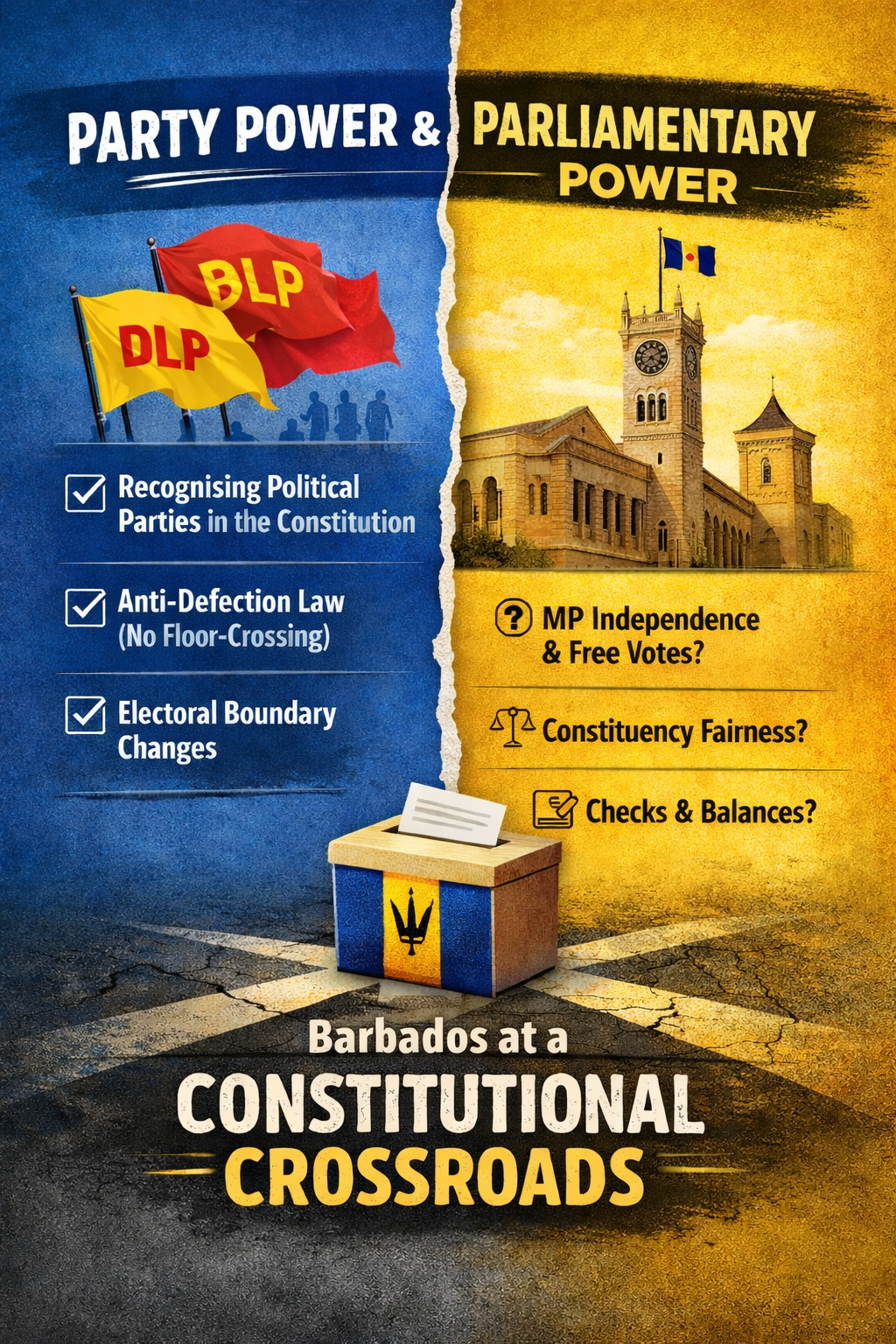
Barbados is once again in a constitutional moment.
Under Prime Minister Mia Mottley, government has proposed amendments that go beyond symbolism and strike at the mechanics of political power itself. Unlike the 2021 transition to a republic, which replaced the monarch with a Barbadian President while leaving the Westminster structure intact, these new proposals touch the inner workings of representation, party control, and electoral design.
At the centre of the debate are three major moves: constitutional recognition of political parties, anti-defection legislation, and adjustments related to electoral boundaries.
For the first time since Independence, political parties would be formally embedded in the Constitution. That may sound like a technical correction — after all, parties already dominate elections — but constitutionally Barbados has always treated Members of Parliament as individuals elected by constituencies, not as agents of party machines. This amendment would shift that balance by recognising parties as core constitutional actors.
Supporters argue this merely reflects political reality. Critics counter that it entrenches party structures in a way the framers of the 1966 Constitution deliberately avoided.
The proposed anti-defection amendment intensifies the debate. Under the proposal, an MP who resigns from, is expelled by, or otherwise leaves the party under which they were elected would be required to vacate their seat and face a by-election. Government’s argument is straightforward: voters elect candidates based on party affiliation, and that mandate should not be altered mid-term.
Opponents see a different danger. They argue that such a rule could discourage dissent, silence independent judgment, and make MPs more accountable to party leadership than to constituents. In a political environment where one party currently holds every seat in the House of Assembly, the optics are powerful. Critics ask whether this reform protects voters — or strengthens party discipline at the expense of parliamentary independence.
Electoral boundary reform adds another layer. Adjusting constituency variances to reflect demographic change may be administratively sound. But any constitutional change affecting boundaries inevitably raises concerns about fairness, neutrality, and political advantage. In tightly contested systems, boundary reform is sensitive. In a system with overwhelming parliamentary dominance, it becomes even more so.
The deeper question is philosophical.
Are these amendments strengthening democratic integrity — ensuring that mandates are respected, that representation aligns with modern political realities, and that electoral maps reflect population shifts?
Or are they consolidating political power by formalising party control within the Constitution itself?
Barbados has historically favoured cautious constitutional evolution. From Independence under Errol Barrow to the 2021 republican transition, structural continuity has defined governance. Symbolic change at the top, preservation of Westminster mechanics below.
This new moment feels different.
These amendments are not about titles or symbols. They are about how power flows between voters, MPs, parties, and Parliament.
Government maintains that reform is necessary to modernise and protect democratic stability. Critics argue that true constitutional reform should be comprehensive, participatory, and carefully sequenced — not selective and parliamentary-driven.
The Constitution is not ordinary legislation. It is the rulebook that governs the governors.
As these amendments move forward, Barbadians must decide whether this is prudent strengthening of democracy — or a recalibration of power that deserves deeper national scrutiny.
The debate is no longer about monarchy versus republic.
It is about party power versus parliamentary independence.
And that is a debate Barbados cannot afford to treat lightly.