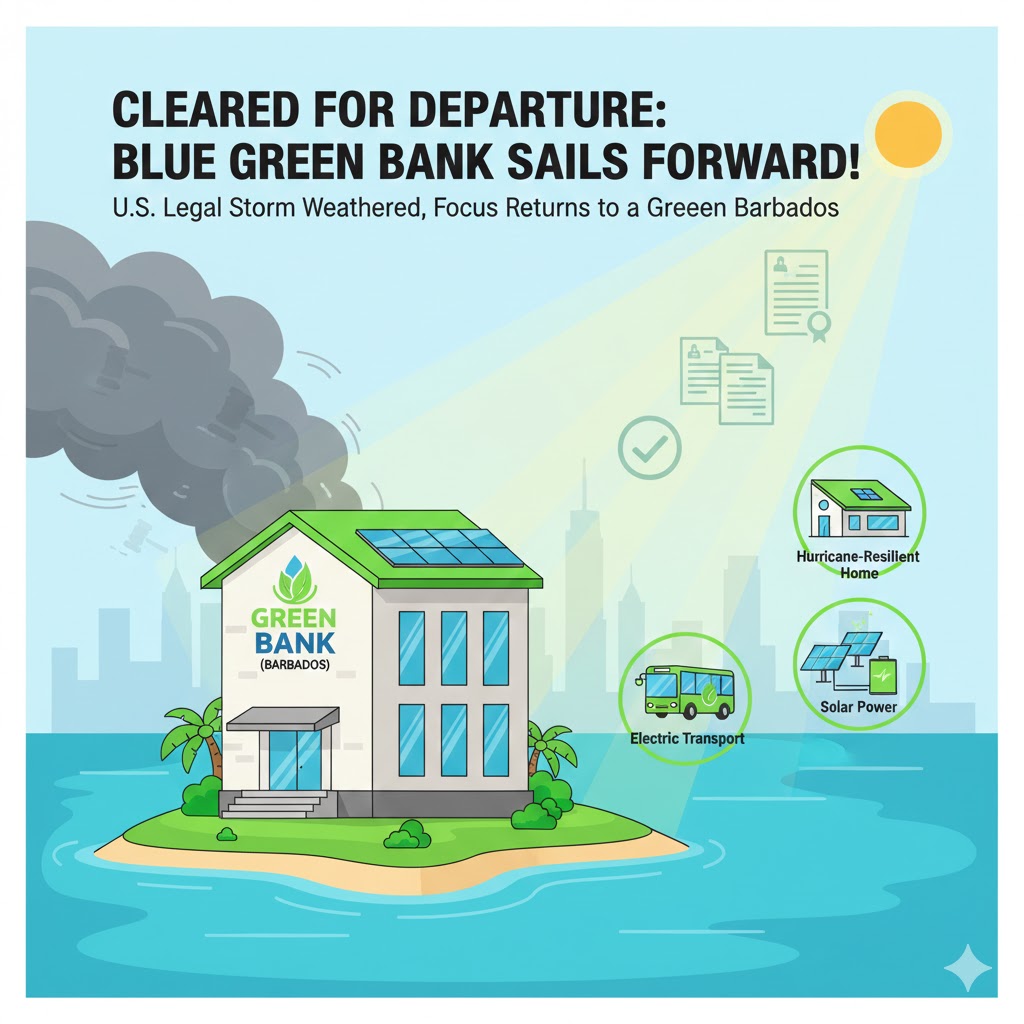
As 2026 begins, Barbados’ flagship climate initiative, the Blue Green Bank (BGB), appears to have successfully navigated its most significant legal hurdle to date. Following a series of complex proceedings in the United States District Court for the Southern District of New York, the cloud of litigation that once threatened the bank’s reputation has been largely dispersed, allowing the institution to focus on its mission of building national resilience. The legal saga, which centered on allegations of fraud and racketeering, reached a definitive conclusion in late December 2025 when Judge Jed S. Rakoff dismissed the final amended complaint filed by the Fintech Leaders Fund (FLF) against Pegasus Capital Advisors.
The lawsuit had alleged that Pegasus, the accredited entity facilitating the bank’s international funding, misled stakeholders regarding the technological capabilities of the bank’s digital platform. However, the New York court ruled that the plaintiffs failed to provide sufficient evidence of a racketeering enterprise or direct injury. While an appeal has been filed in the Second Circuit Court of Appeals, the dismissal in the District Court represents a major victory for the project’s architects. The Government of Barbados has maintained throughout the process that the dispute was a private matter between third-party entities, stressing that no public Bajan funds were ever at risk during the litigation. This case is the latest in a series of high-profile matters involving Barbadian interests in U.S. courts, following the 2021 sentencing of former Minister Donville Inniss. Unlike the Inniss case, which involved criminal prosecution of an official, the Blue Green Bank litigation was a civil commercial dispute, yet it highlighted the increasing reach of U.S. financial regulations into international climate-finance projects.
With the primary legal distractions now in the rearview mirror, the Blue Green Bank—formally the Blue-Green Investment Corporation—is accelerating its local operations. The bank is currently working with an initial capital injection of approximately $50 million BDS, derived from the Green Climate Fund and IMF-related savings, with an ultimate goal to mobilize a staggering $500 million BDS in lending capacity for the Bajan public. The BGB does not operate as a traditional commercial bank where citizens walk in to open a savings account; instead, it acts as a wholesaler of finance. It partners with local credit unions and commercial lenders to provide guarantees and low-cost capital, allowing local financial institutions to offer specialized Green Loans with lower interest rates and longer repayment terms than were previously available on the market.
The bank’s operational focus for the first half of 2026 remains centered on three key areas designed to protect the average household. First, it is providing the financing necessary for homeowners to retrofit roofs and windows against the increasing threat of severe weather through hurricane-resilient housing initiatives. Second, it is supporting the installation of solar PV systems for residential and small business use to reduce long-term electricity costs. Finally, the bank is facilitating the shift toward electric vehicles for both private owners and public service vehicle operators through tailored loan packages. Government officials, including Minister in the Ministry of Finance Ryan Straughn, have reiterated that the Blue Green Bank is a cornerstone of the Bridgetown Initiative, aiming to prove that climate resilience is a practical financial tool for the public. As the institution finalizes its headquarters in Bridgetown this year, the focus remains squarely on delivering the green promises made to the electorate.