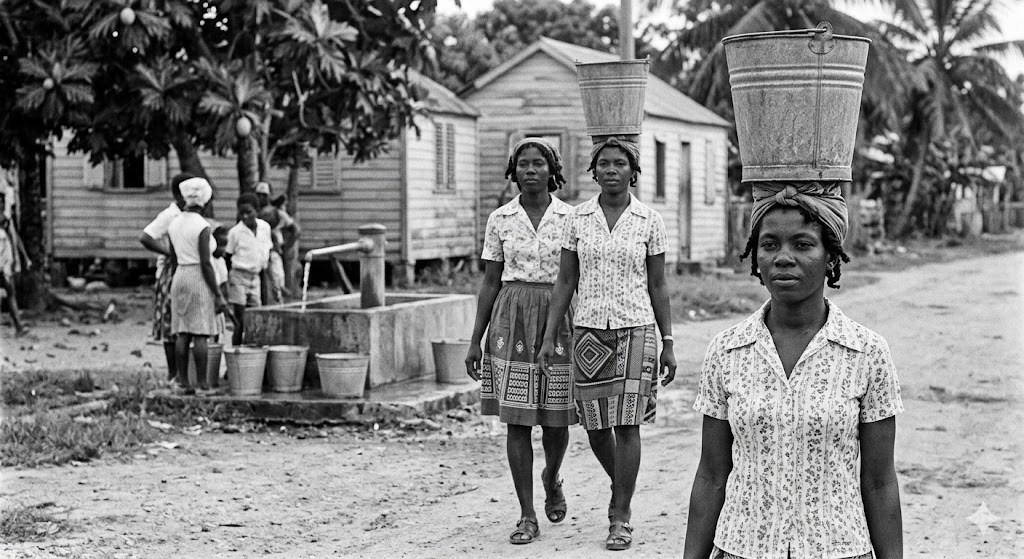
If Barbados is to survive an increasingly thirsty future, we must stop looking solely underground for our salvation and start looking at our own rooftops. By moving away from a purely centralized grid and reclaiming the “Spring Mentality” once seen at Walkes Spring and Three Houses, we can transform our modern water crisis into a culture of individual empowerment and heritage-driven resilience.
Bermuda has turned every home into a self-sustaining water plant through its iconic stepped, white-washed roofs, proving that architectural ingenuity can solve a natural deficit.
The transition to deep-well pumping from aquifers like the Belle and Hampton was a logistical necessity as the Barbadian population decentralized and demand increased, but it came at a psychological cost. When water is piped from a hidden source miles away, the instinct to conserve vanishes. Historically, the natural flow from Three Houses was allowed to run wastefully into the sea for years, and today it remains only a trickle.
By adopting a “roof-to-tank” system, we effectively create a modern, private “BWA” for every household. This is particularly critical in many of our new housing developments, where rain currently runs off concrete yards and paved surfaces into the gutters, completely unutilized. Installing catchment tanks in these areas would capture that runoff, allowing families to use harvested rain for flushing toilets and laundry—drastically reducing the daily burden on the Barbados Water Authority.
We do not need rigid new laws to force this shift; we need to lead by education and example. Transforming our schools and government buildings into demonstration hubs for rainwater harvesting shows the public that self-reliance is possible. When a homeowner can look into their own cistern and see the water level—much like our ancestors who had to collect water from the standpipe or natural springs, the habit of waste naturally disappears.
Coupled with the disciplined conservation techniques practiced in islands like Anguilla, where children are taught the value of every drop even during a bath, this decentralized model ensures that every roof in Barbados becomes a personal reservoir. By encouraging new developments to catch and use their own rain for non-potable needs rather than letting it escape down the drain, we move from being a “water-scarce” island to a “water-wise” nation.