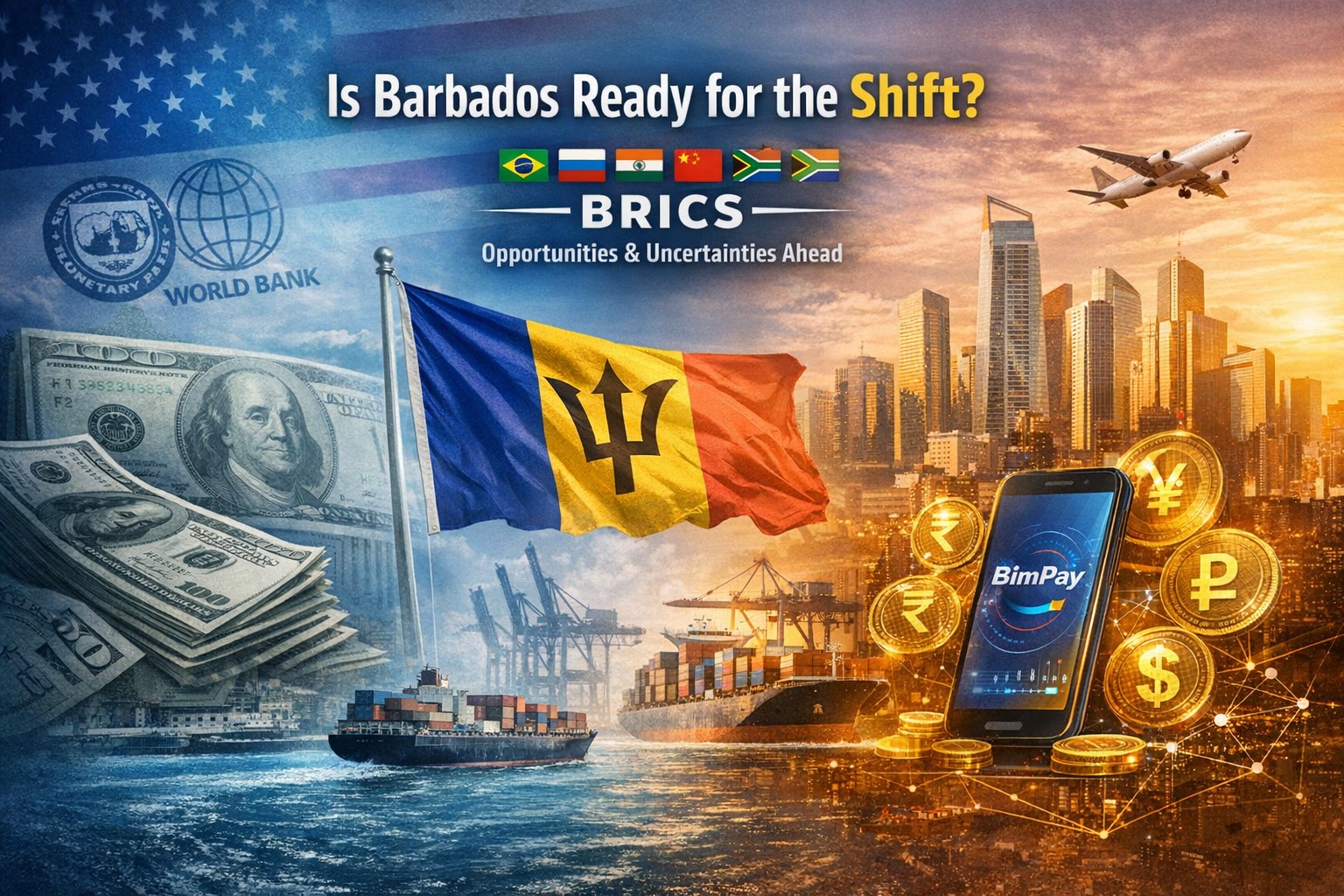
The global financial system is beginning to shift—and Barbados cannot afford to ignore it. The growing influence of BRICS is not a distant development; it is already altering how countries trade, move money, and position themselves in a changing world order.
For decades, Barbados has operated within a stable, Western-aligned financial system, anchored by institutions such as the International Monetary Fund and the World Bank, and reinforced by the Barbados dollar’s long-standing peg to the US dollar. That system has provided predictability and confidence. But stability should not be mistaken for permanence.
The expansion of BRICS signals a shift toward a more multipolar global economy. Trade is increasingly being settled in local currencies. Alternative payment systems are being explored. New financial relationships are forming outside traditional channels. These developments may appear gradual, but their long-term effects could be profound—particularly for small, import-dependent economies like Barbados.
There are clear opportunities. Diversifying trade relationships could reduce costs and improve supply resilience. New tourism markets could emerge from countries such as India and China. Access to alternative financing through institutions like the New Development Bank could provide additional flexibility for national development.
At the same time, the risks cannot be ignored. Barbados’ economic model remains closely tied to the existing global financial system. Any meaningful shift away from US dollar dominance, or disruption to established banking channels, could introduce new uncertainties. For a small state, even modest changes in global financial flows can have significant consequences.
This is where the discussion moves from global trends to local strategy.
Is Barbados preparing for these changes—or simply observing them?
The concept of BimPay raises an important question. If developed with foresight, it could become more than a local payment solution. It could serve as a flexible financial layer, capable of interfacing with both traditional systems and emerging alternatives. In a world where payment networks may become more fragmented, that flexibility could prove critical.
More importantly, BimPay could act as a buffer against external shocks. Reducing reliance on foreign payment channels, lowering transaction costs, and enabling multi-currency transactions are not just conveniences—they are forms of economic resilience.
However, this outcome is not guaranteed. Without scale, interoperability, and strong institutional backing, BimPay risks remaining a limited domestic tool rather than evolving into a strategic national asset.
BRICS will not arrive with a single announcement or a clear launch date. By the time its financial systems become fully operational and influential, the global landscape will have already shifted.
The real question is not when BRICS will be ready.
It is whether Barbados will be.