War in the Middle East is never a “distant” drama for Barbados. For a small, import-dependent economy, it is a localised economic risk. As the confrontation between the United States and Iran widens, the shockwaves are traveling faster than the headlines.
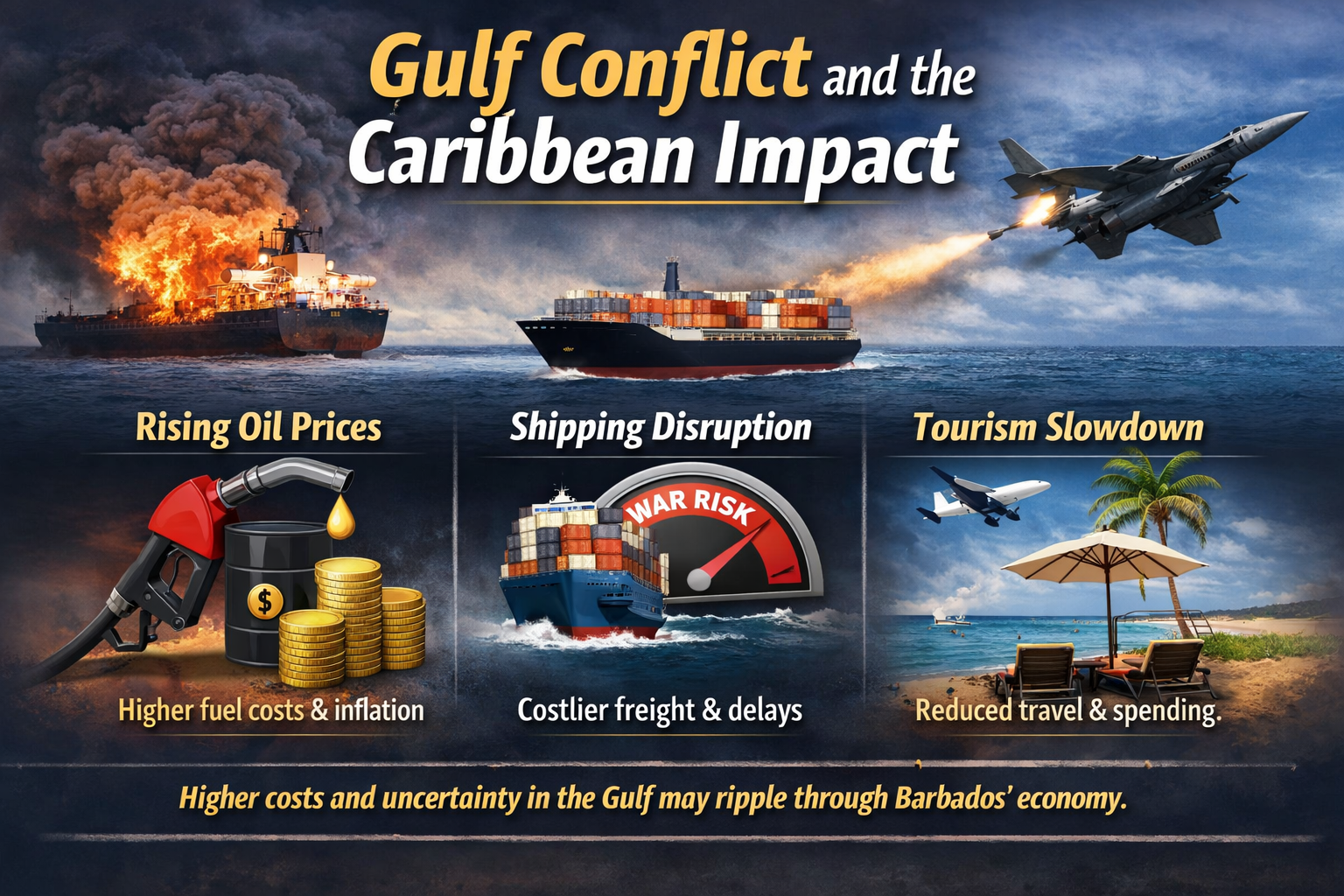
Energy is the invisible thread in every Barbadian sector. With the Strait of Hormuz currently restricted and Brent crude surging past $85 per barrel, the fact that Barbados imports virtually all its fuel means these global spikes translate directly into higher landed costs. This is not just about the price at the pump; it is a tax on electricity generation, manufacturing, and food distribution. When the cost of a kilowatt-hour or a gallon of diesel rises, the price of a grocery bill or the cost of a trip in a bus fare inevitably follows.
Furthermore, global shipping operates as a single, sensitive network. Even if cargo bound for the Bridgetown Port does not pass through the Gulf, the crisis will force marine insurers to hike war-risk premiums and carriers to reroute vessels. With emergency freight surcharges already being implemented by major lines, the landed cost of goods is rising. For an import-heavy economy, these costs are passed from wholesalers to retailers, and ultimately, to the Barbadian consumer.
Tourism—the island’s lifeblood—is equally sensitive to this global anxiety. Surging oil prices force airlines to choose between hiking fares, adding fuel surcharges, or cutting routes. With Barbados relying heavily on visitors from the UK and North America, energy-driven inflation in those markets squeezes discretionary spending. When families in London or New York reassess their holiday budgets, Barbadian hotel occupancies and restaurant revenues feel the chill.
This volatility also triggers a “flight to safety” in global financial markets, often tightening liquidity and hardening borrowing conditions for emerging economies. While Barbados has built external buffers, a prolonged conflict could pressure exchange rate stability and dampen the investment appetite needed for the island’s long-term infrastructure goals.
This is not alarmism; it is the geography of an interconnected world. A brief flare-up causes volatility, but a sustained conflict creates a three-front crisis: rising input costs, reduced consumer purchasing power, and potential strain on foreign exchange.
For Barbados, stability in the Gulf is not a diplomatic preference—it is a foundational economic necessity.