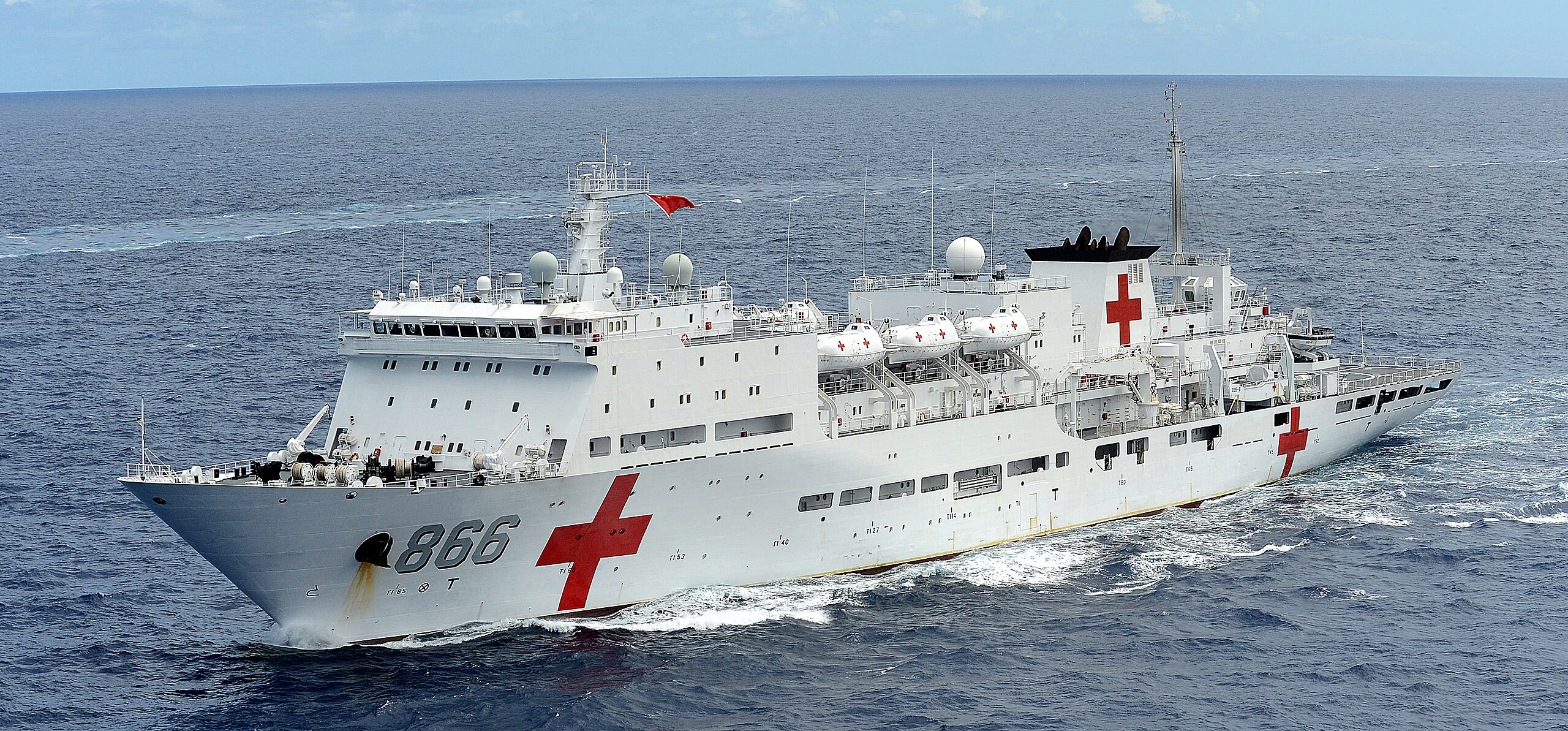
People’s Republic of China, People’s Liberation Army (Navy) ship PLA(N) Peace Ark
January 3, 2026
The start of 2026 has brought the perennial debate over Barbadian healthcare back to the boiling point. While the government rolls out its ambitious QEH Strategy 2025–2028, a familiar and vocal critic is warning that no amount of shiny new equipment will save a system that is fundamentally broken at its roots. Former Minister of Health Donville Inniss has recently reignited a firestorm of discussion, offering a blunt assessment of the Queen Elizabeth Hospital (QEH) and the wider healthcare network. His message is clear: the QEH is being sacrificed on the altar of a failing primary care system.
The most stinging of Inniss’ recent remarks came following the visit of the Chinese hospital ship, Peace Ark. While the government welcomed the humanitarian mission, Inniss described the sights of hundreds of Barbadians lining up for basic medical checks on a ship as “embarrassing.” He argued that while the assistance is appreciated, reliance on a floating healthcare facility is a glaring symptom of a deteriorating state of public health. For Inniss, the long lines at the port are a mirror reflecting the failure of the island’s polyclinics to manage chronic conditions before they become emergencies.
One of the most controversial points in the current debate is the government’s focus on massive capital investment. The QEH is currently undergoing a multi-million dollar technological transformation, funded largely through partnerships with the European Investment Bank (EIB). This includes everything from new ICT devices to the long-awaited commissioning of a linear accelerator for cancer treatment. However, Inniss contends that the “begging hat” syndrome—where the QEH constantly asks the Treasury for more money—will continue until health economists and planners are brought in to accurately measure and cost hospital functions.
Inniss further pointed out that building a $400 million oncology center at the Enmore Development is a hollow victory if the island still lacks the specialized oncologists and palliative care teams needed to man it. He noted that what gets measured gets done, suggesting that hospital management has historically failed to accurately track patient outcomes and equipment uptime, leading to significant resource waste.
In response to these critiques, the QEH leadership has highlighted the hospital’s new three-year strategy which aims to move away from simply adding beds and toward efficiency of stay. The hospital has launched “Estimated Date of Discharge” boards at patients’ bedsides to reduce the “bed blocker” issue, where patients remain in hospital because they have no safe home environment to return to. Additionally, the arrival of hundreds of new computers and tablets is part of a push to create a fully integrated digital medical record system, aiming to cut down wait times in the Accident & Emergency department.
Perhaps Inniss’ most sobering warning concerns the economic impact on the average Bajan. He argues that as the public system falters, middle-income earners are being forced into the private sector. This is creating a class of “working poor”—people who earn too much for state assistance but are being drained dry by private medical insurance and out-of-pocket costs for basic diagnostics. Inniss continues to reject calls for means testing, sticking to his guns on a socialized healthcare model where everyone contributes to a central pool, but he warns that without the political will to reform the polyclinics, the QEH will remain the “heat-taker” for every failure in the system.
As we move into 2026, the QEH stands at a crossroads. It is better equipped than it has been in a decade, but as the former Minister reminds us, equipment doesn’t treat patients—people and systems do.